4-month sleep regression: a calm 14-night plan
Last updated 19 November 2026
How this was written: Researched from the sources listed below and drafted with AI assistance, then edited by Devid. Not reviewed by a doctor or sleep specialist.
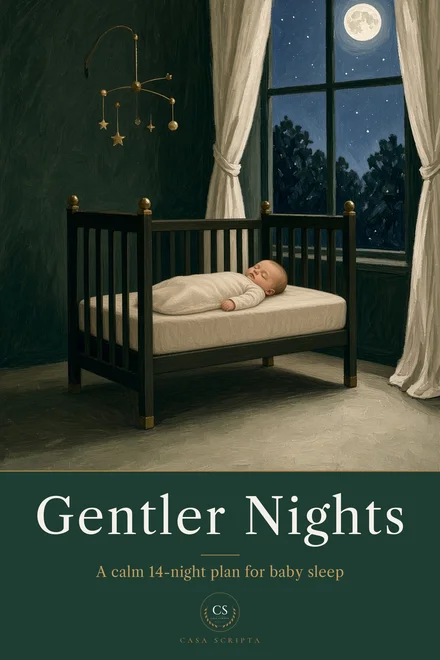
Your baby was finally sleeping in longer stretches, and now they wake every hour or two. That's the 4-month sleep regression, and it's a sign your baby's sleep is growing up, not a sign you've done something wrong. Here's what's going on, and a gentle, no-cry 14-night plan you can start tonight.
Not medical advice. This is general information only. Talk to your pediatrician, doctor or child health nurse about your baby. In an emergency, call 911 (US and Canada), 999 (UK) or 000 (Australia).
What the 4-month sleep regression really is
"4-month regression" is a popular phrase, not a medical diagnosis. Raising Children Network says "regression" isn't a good word for it, because changes in baby sleep over the first year are developmentally normal (Raising Children Network).
What does change around this age is real:
- The body clock switches on. A day–night melatonin rhythm appears at around 9–15 weeks (Kennaway et al. 1996).
- Sleep becomes more adult-like. Distinct light and deep sleep stages can usually be seen by about 4–4.5 months (Grigg-Damberger et al. 2007).
- Sleep cycles are short, around 30–60 minutes. Tresillian says it's "very common for babies to wake up after 30–40 minutes sleep at this age" (Tresillian).
Night waking is also simply normal. In the first 6 months, babies need to wake at night to feed (Raising Children Network). In a Quebec study of 1,741 children, almost a quarter of 5-month-olds weren't sleeping 6 hours in a row (Touchette et al. 2005).
Safe sleep first, every sleep
Before you change anything about settling, make every sleep safe, day and night, until your baby's first birthday:
- Back to sleep: put your baby down on their back for every sleep (AAP 2022 policy; NHS; Red Nose).
- Firm, flat, separate surface: a crib or bassinet with a firm, flat, well-fitting mattress, in your room for at least the first 6 months, not in your bed or on a sofa (AAP 2022 policy; NHS).
- Nothing loose in the crib: no pillows, comforters, bumpers, soft toys or loose bedding (AAP 2022 policy; Red Nose).
- No smoking: keep your baby away from smoke, before and after birth (AAP 2022 policy; NHS; Red Nose).
One more that matters at exactly this age: the AAP says swaddling is no longer appropriate once a baby shows signs of trying to roll (AAP 2022 policy). We follow the stricter rule: stop arms-in swaddling by 4 months or at any sign of rolling, whichever comes first, and switch to an arms-out sleep sack.
Before Night 1: three days of setup
Don't change your baby's sleep yet. Just get ready.
- Check the red flags in the doctor section below. If any apply, see your pediatrician first.
- Keep a rough sleep diary for 2–3 days. Note when your baby sleeps, how they fall asleep and when they feed. "2:10, fed, back down 2:40" is plenty. On Day 14 you'll compare against it, because tired memories aren't reliable.
- Make a partner plan. Agree on who does bedtime, who takes which wakings and what you both do, so your baby gets the same response.
- Pick a realistic bedtime based on when your baby actually falls asleep in your diary.
The 14-night plan
Feed your baby whenever they seem hungry, every night. You're working on how your baby settles, not on stopping feeds (Raising Children Network).
Nights 1–3: Rhythm. Do the same short bedtime routine every night, for example: feed in a calm, dim room; a bath or warm wash; diaper and sleep sack; one quiet thing like the same song; lights out. A consistent routine has the best evidence of any gentle approach. In a randomized trial, a simple routine improved settling and night waking within 2 weeks, though those babies were 7–18 months old and the study was industry-funded (Mindell et al. 2009). Daylight and play by day; dark, quiet, boring nights. Settle however works for now.
Nights 4–7: Gentle settling. Move the feed earlier in the routine so your baby isn't usually asleep on the breast or bottle. Put them in the crib drowsy but awake, which the AAP suggests from 4 months (AAP HealthyChildren). Then use the lightest help that works: your voice, then gentle patting in the crib, then picking up to calm and trying again (Raising Children, responsive settling). Under 6 months, don't leave your baby to cry for more than a couple of minutes.
Nights 8–14: Consolidate. Same routine, same responses. If hands-on settling is going well, you may need less of it. Let your baby lead; there's no withdrawal schedule under 6 months.
If a night falls apart, settle your baby however you need to and try again tomorrow. If you feel yourself losing it at 3am, put your baby down safely on their back in the crib, step out and take a few minutes.
Day 14: an honest review
Fourteen nights is the length of the plan, not a promised result. Results vary, because every baby is different and no study has tested this exact plan. Compare your diary with the last three nights, including your own mood. Some progress but not there yet is common. Gradual methods are often described as taking 1–3 weeks (Raising Children Network), so carry on if it's helping.
When to call your doctor
Call your pediatrician or doctor if your baby snores most nights, pauses or gasps while breathing, or breathes with effort; vomits green or blood, or vomits forcefully; refuses feeds, isn't gaining weight well or seems dehydrated; has a fever or seems unwell; or if their sleep suddenly changes along with signs of illness or pain (RCH, obstructive sleep apnoea; NICE NG1; RCH Kids Health Info).
Call your emergency number now if your baby has difficulty breathing, or seems very unwell, floppy or unusually drowsy (healthdirect).
FAQ
How long does the 4-month sleep regression last? There's no fixed length, because it isn't a defined medical condition. Sleep keeps changing through the first year.
Do I have to let my baby cry? No. This plan uses responsive settling. A large Australian trial found no long-term harm from controlled comforting or camping out (Price et al. 2012), so the choice is about your values, not danger.
Should I stop night feeds? No. Babies this age need night feeds, so feed whenever your baby seems hungry.
A simple bedtime routine sits underneath this plan; see our bedtime routine for a 4 to 6 month old. You can also download the free Safe Sleep Checklist, in A4 and US Letter.
FREE CHECKLIST BY EMAIL
Email me the Calmer Nights checklist
Optional. We'll email you a link to confirm your address, and confirming opens the checklist. You'll also get occasional tips and new Casa Scripta guides; unsubscribe any time.
Want the full plan?
If you'd like every step in one place, our Casa Scripta guide, Gentler Nights, has the full safe-sleep chapter, a separate track for babies from 6 months, printable diaries, trackers and a Day 14 review worksheet. It's a plan, not a promise. You can also read about it on the Gentler Nights book page.
Sources
- American Academy of Pediatrics, 2022 safe sleep policy: https://doi.org/10.1542/peds.2022-057990
- AAP HealthyChildren: https://www.healthychildren.org
- NHS, Reduce the risk of SIDS: https://www.nhs.uk/baby/caring-for-a-newborn/reduce-the-risk-of-sudden-infant-death-syndrome/
- Red Nose Australia, Six safe sleep recommendations: https://rednose.org.au/safe-sleep-and-safer-pregnancy/pregnancy-to-birth/six-safe-sleep-recommendations/
- Raising Children Network: https://raisingchildren.net.au
- Tresillian, Baby sleep 3–6 months: https://www.tresillian.org.au/baby/sleep/3-to-6-months/
- Royal Children's Hospital Melbourne: https://www.rch.org.au/kidsinfo/
- NICE NG1: https://www.nice.org.uk/guidance/ng1
- healthdirect: https://www.healthdirect.gov.au
- Studies linked inline: Kennaway 1996, Grigg-Damberger 2007, Touchette 2005, Mindell 2009, Price 2012