Bedtime routine for a 4 to 6 month old: a calm, simple guide
Last updated 20 November 2026
How this was written: Researched from the sources listed below and drafted with AI assistance, then edited by Devid. Not reviewed by a doctor or sleep specialist.
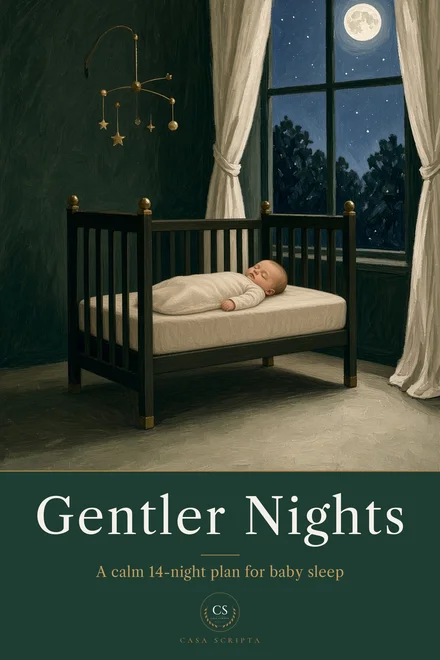
Somewhere around four months, evenings can start to feel like a negotiation. Your baby is more alert, more curious, and harder to wind down, and bedtime drifts later every week. A short, predictable bedtime routine is one of the gentlest things you can add at this age. It isn't magic, and it doesn't involve leaving your baby to cry. Here's what the research says, what a simple routine looks like, and how to make it stick.
Not medical advice. This is general information only. Talk to your pediatrician, doctor or child health nurse about your baby. In an emergency, call 911 (US and Canada), 999 (UK) or 000 (Australia).
Why a bedtime routine is worth it at this age
Of all the gentle approaches to baby sleep, a consistent bedtime routine has some of the best support. In a large survey of mothers of 10,085 children aged 0 to 5 in Asia, Australia, New Zealand, the UK and North America, a regular bedtime routine was linked with earlier bedtimes, falling asleep faster, fewer night wakings and longer sleep. The more nights a week families used one, the better the results tended to be (Mindell et al. 2015). That's an association, not proof, but the pattern was consistent.
In a randomized trial, a simple three-step routine of bath, massage and a quiet activity, with lights out within 30 minutes of the bath, improved settling and night waking within two weeks (Mindell et al. 2009). To be honest about that study: the babies were 7 to 18 months old, and it was funded by a baby-products company. I haven't found a trial of exactly this kind in 4 to 6 month olds.
The guidance for younger babies points the same way. Raising Children Network lists "start a sleep routine" among its tips for 3 to 6 month olds, alongside putting your baby down drowsy but awake (Raising Children Network). The Royal Children's Hospital Melbourne notes that by around six months, a child "can predict and respond to positive routines" (RCH Kids Health Info). Starting a little before that gives the routine time to become familiar.
Safe sleep comes first
A routine is about the minutes before sleep. Safe sleep is about every sleep itself, day and night, until your baby's first birthday:
- On their back for every sleep, on a firm, flat, separate surface such as a crib or bassinet, in your room for at least the first 6 months (AAP 2022 policy; NHS).
- Nothing loose in the crib: no pillows, bumpers, loose bedding or soft toys. The RCH advises against giving a comforter to babies under twelve months, as it can be a choking or suffocation hazard (RCH).
- Arms out once rolling: the AAP says swaddling is no longer appropriate once a baby shows signs of trying to roll (AAP 2022 policy). An arms-out sleep sack works well in a routine.
- Not too hot: the NHS suggests a room temperature of about 16 to 20°C (about 61 to 68°F) (NHS).
- A smoke-free home, before and after birth (AAP 2022 policy).
No routine, product or settling method prevents SIDS. These safe-sleep basics are what lower the risk.
A simple bedtime routine, step by step
Tresillian describes a 3 to 6 month bedtime routine that takes place after the last milk feed: a bath, a gentle massage, nappy and pajamas, stories, rhymes or songs in a soft, low voice, warm cuddles, then your baby on their back in their own bed, lights out (Tresillian). The NHS suggests very similar steps (NHS). Here's how I'd put it together:
| Step | What to do |
|---|---|
| 1. Feed | A calm feed in a quiet, dimly lit room. |
| 2. Bath or wash | A warm bath, or a quick warm wash on busy nights. |
| 3. Massage | A minute or two of gentle massage, if your baby enjoys it. |
| 4. Nappy and sleep sack | Fresh nappy, pajamas, arms-out sleep sack. |
| 5. One quiet thing | The same song, rhyme or short book, in a low, soft voice. |
| 6. Down and lights out | On their back in the crib, drowsy but awake if you can, then lights out. |
About 20 to 30 minutes is plenty. How long you spend is up to you, as Tresillian puts it. What matters is that the steps come in the same order, so your baby starts to recognize where the evening is heading.
Where the feed fits
At this age, feeds come first. In the first 6 months, babies need to wake at night to feed (Raising Children Network), so feed your baby whenever they seem hungry, at bedtime and overnight.
Raising Children Network also says it's "completely fine to rock or feed your baby to sleep if this sleep association suits your baby and you." If it's working for you, you don't need to change it.
If your baby always falls asleep feeding and then struggles to resettle overnight, you could gently move the feed earlier in the routine. The RCH suggests timing the last feed at least half an hour before bedtime, and perhaps outside the bedroom (RCH). The AAP suggests putting babies 4 months and older down drowsy but awake, so they learn to fall asleep in their own bed (AAP HealthyChildren). Go slowly. Some nights it won't happen, and that's fine.
Choosing a bedtime
There's no single right bedtime. The most useful clue is your baby. Tresillian lists tired signs such as yawning, grizzling, staring, rubbing eyes, clenching fists and fussiness, and suggests starting the routine before your baby becomes overtired (Tresillian).
A few days of a rough sleep diary helps. Note when your baby actually falls asleep, then start the routine about half an hour before that. For context, Tresillian says most babies this age sleep around 14 or 15 hours across day and night, with 2 to 3 daytime naps. Treat those as rough guides. Babies vary.
If you're tempted to keep your baby up later so they'll sleep longer: in a large US poll, later bedtimes in young children were linked with less total sleep, not more (Mindell et al. 2009, poll).
Make nights different from days
Around this age, babies start to have their longest sleep at night. Raising Children Network suggests keeping night-time dark or dimly lit and quiet, using a dim light when you attend to your baby, and keeping daytime brighter and more playful (Raising Children Network). Your routine is the bridge between the two: it's where the house gets quieter and the lights go down.
Keep it the same, not perfect
Consistency matters more than any single step. A few things make that easier:
- Keep it short, so you can do it on tired nights too.
- Share it. If you're co-parenting, the RCH suggests sharing the routine and strategies with your partner so your child has consistency.
- Have a travel version. Sleep sack, the same song and lights out works at grandma's house too.
- Expect setbacks. Illness, teething and developmental changes can all disrupt sleep. The RCH says it's okay to pause the routine when your child is sick and return to it later, and it may feel harder at first when you do (RCH).
If the 4-month changes are hitting hard, my calm 14-night plan for the 4-month sleep regression builds on this routine, night by night.
When to call your doctor
A routine can't fix sleep problems caused by illness. Call your pediatrician or doctor if your baby snores most nights, pauses or gasps while breathing, refuses feeds or isn't gaining weight well, has a fever or seems unwell, or if their sleep suddenly changes along with signs of illness or pain. Call your emergency number now if your baby has difficulty breathing, or seems very unwell, floppy or unusually drowsy. And if you're struggling yourself, your doctor or child health nurse is there for you too.
FAQ
Does my baby need a bath every night? No. A bath is a nice, calming step, but the order of the routine matters more than any one part. A warm wash works on busy nights.
Is 4 months too early to start? No. Raising Children Network suggests starting a routine at 3 to 6 months, when it feels right for your baby and you.
Will a routine make my baby sleep through the night? It may help your baby settle more easily, but it isn't a promise. Babies this age still need night feeds, and every baby is different.
You can also download our free one-page Safe Sleep Checklist, in A4 and US Letter.
FREE CHECKLIST BY EMAIL
Email me the Calmer Nights checklist
Optional. We'll email you a link to confirm your address, and confirming opens the checklist. You'll also get occasional tips and new Casa Scripta guides; unsubscribe any time.
Want the full plan?
If you'd like this routine built into a step-by-step plan, my Casa Scripta guide, Gentler Nights, has a full safe-sleep chapter, a gentle 14-night plan with no cry-it-out, printable sleep diaries and a bedtime routine card. It's a plan, not a promise. You can also read about it on the Gentler Nights book page.
Sources
- American Academy of Pediatrics, 2022 safe sleep policy: https://doi.org/10.1542/peds.2022-057990
- AAP HealthyChildren, Getting your baby to sleep: https://www.healthychildren.org/English/ages-stages/baby/sleep/Pages/Getting-Your-Baby-to-Sleep.aspx
- NHS, Helping your baby to sleep: https://www.nhs.uk/baby/caring-for-a-newborn/helping-your-baby-to-sleep/
- NHS, Reduce the risk of SIDS: https://www.nhs.uk/baby/caring-for-a-newborn/reduce-the-risk-of-sudden-infant-death-syndrome/
- Raising Children Network, Sleep and settling at 3 to 6 months: https://raisingchildren.net.au/babies/sleep/settling-routines/helping-babies-sleep-settle-3-6-months
- Tresillian, Baby sleep 3 to 6 months: https://www.tresillian.org.au/baby/sleep/3-to-6-months/
- Royal Children's Hospital Melbourne, Sleep problems in babies and toddlers: https://www.rch.org.au/kidsinfo/fact_sheets/sleep_problems_babies_and_toddlers/
- Studies linked inline: Mindell 2015, Mindell 2009 (trial), Mindell 2009 (poll)