Dog separation anxiety in apartments: a week-one plan
Last updated 19 November 2026
How this was written: Researched from the sources listed below and drafted with AI assistance, then edited by Devid. Not reviewed by a vet.
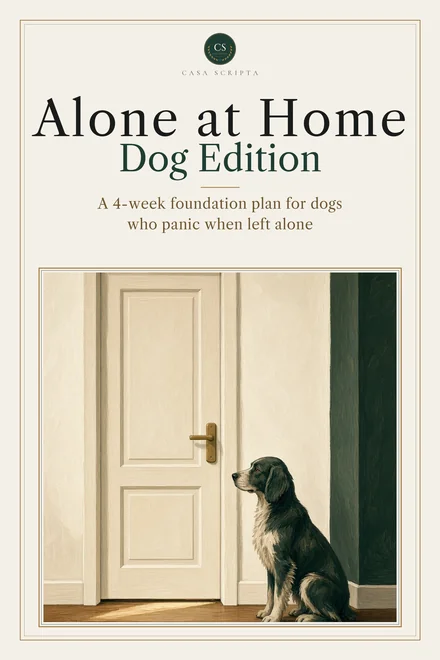
You close the door, and before you reach the elevator the howling starts. By evening there's a note from a neighbor or an email from the building manager. Dog separation anxiety in apartments is stressful because the whole building hears it. Your dog isn't being spiteful, and you're not a bad owner. This week-one plan helps you calm the crisis, protect your neighbors' patience and set up gentle, force-free training.
Not veterinary advice. This is general information only. Talk to your vet or a qualified behavior professional about your dog. In an emergency, contact your nearest emergency vet.
Why dog separation anxiety in apartments starts the moment you leave
When researchers filmed dogs with separation-related behavior, vocalizing started after an average of 3.25 minutes alone, and most signs appeared within the first 10 minutes (Palestrini et al. 2010). Blue Cross says the first 15 minutes are usually the worst (Blue Cross). That's why neighbors hear it so fast, and why training starts with very short absences.
You're far from alone. PDSA's 2024 survey found 11% of UK dogs showed distress when left alone (PDSA PAW Report 2024).
Step 0: check the vet-first red flags
Pain and illness can cause or worsen behavior problems (Mills et al. 2020). See a vet before you start if your dog:
- hurts themselves trying to get out (broken teeth, torn nails, cut paws or mouth)
- tries to escape through doors or windows, or out of a crate
- won't eat or drink when alone, or drools or pants heavily
- has accidents in the house
- changes suddenly, especially an older dog
- shows signs of pain, such as limping or stiffness
(ASPCA; Dogs Trust; Mills et al. 2020)
Also ask your vet for help if your dog panics at fireworks or in many situations, or if you're under time pressure such as a formal warning from your landlord. Don't give any medication, supplement or calming product without talking to your vet.
The no-panic rule: the heart of week one
This week's goal isn't training progress. It's to stop your dog being left alone longer than they can cope with, just while you train.
The ASPCA explains that during treatment, "your dog cannot be left alone except during your desensitization sessions" (ASPCA). Dogs Trust admits this is hard to organize, but says "this is the only way to stop the problem getting worse" (Dogs Trust). To be honest about the evidence: no study has tested this rule on its own. It's expert guidance that every major charity we reviewed asks for.
There's a practical bonus in an apartment: when your dog isn't alone, there's no alone-time howling for neighbors to hear. That isn't a training result. It buys you breathing room.
Build a cover plan tonight
You don't need one perfect solution, just a patchwork for seven days. List every time you'll be out, then write who or what covers each one, plus a backup. Options from the ASPCA, Dogs Trust and RSPCA:
- Take your dog with you to a dog-friendly workplace or on dog-safe errands.
- Friends or family, at your place or theirs.
- A pet sitter or a dog walker to break up a long day (RSPCA).
- Doggy daycare, if your dog copes well with busy, noisy places.
- Swaps: trade dog-sitting with a neighbor, or work from home some days.
Two tips: batch errands so you leave once, not four times, and count the short trips. A quick run to the mailroom or garbage chute is an absence too. Never leave your dog in a car in warm weather. The ASPCA warns dogs can die of heatstroke at 70°F (about 21°C) and up, "even for just a few minutes."
Film one short departure
You can't fix what you can't see. Dogs Trust's advice is simple: "Spy on your dog!" (Dogs Trust). Any camera that records sound works, such as an old phone or a laptop webcam. Point it at the door.
If your dog has no red flags and you can come back the moment they show worry, film one normal departure. Watch live and return at the first sign of stress. Write down how long it took and what you saw: whining, pacing, panting, scratching at the door. That number is your starting line.
Talk to your neighbors early
Neighbors are usually most annoyed when they think nobody cares. A short, friendly note can change the tone: say sorry, explain you've arranged care so your dog won't be left alone for long stretches, mention you're following a gentle training plan, and leave your number. Don't promise a date. If you rent, check your lease and building rules, and reply promptly and in writing to any letter. This isn't legal advice; rules differ everywhere.
First gentle training steps
Once cover is in place, add two small habits:
- Departure-cue practice. Pick up your keys, then put them down and carry on. Repeat a few times a day, about 5 minutes total, until your dog barely notices. Then move to shoes, coat or bag (ASPCA).
- Tiny absences. The ASPCA's rule is to "plan your absences to be shorter than the time it takes for your dog to become upset." Start at an inside door, such as the bathroom. Step out for a few seconds, come back calmly before any worry, and end while it's going well. If you see stress, make the next absences shorter.
Keep hellos and goodbyes calm and kind, not cold. Never punish mess you find later; your dog can't connect it to something hours ago (Blue Cross).
An honest timeline
Week one is damage control, not a cure. In trials, owner-led training was measured over 8 to 12 weeks, and after 12 weeks 56% of owners reported significant improvement (Blackwell et al. 2006). Specialist Malena DeMartini advises owners to "think in terms of months, not weeks" (DeMartini). Results vary, and many dogs need months.
FAQ
Should I use a bark collar? No. The American Veterinary Society of Animal Behavior says aversive methods "should not be used under any circumstances" (AVSAB).
Will a food puzzle fix it? It's good enrichment, not a cure. The ASPCA notes highly anxious dogs often won't eat when alone, so an untouched toy is a sign of worry.
What if I can't cover one absence? Keep it as short as you can and film it. If the video shows red flags, call your vet before leaving your dog again.
If you want to know how long your dog can be left alone while you train, see How long can a dog with separation anxiety be left alone?. You can also download the free Vet-First Red Flags Checklist, in A4 and US Letter.
FREE CHECKLIST BY EMAIL
Email me the Home Alone, Calmer checklist
Optional. We'll email you a link to confirm your address, and confirming opens the checklist. You'll also get occasional tips and new Casa Scripta guides; unsubscribe any time.
Want the whole plan?
If you'd like the next steps laid out, our Casa Scripta guide, Alone at Home, Dog Edition, adds a 4-week foundation plan, neighbor and landlord templates, and printable logs. It's a plan, not a promise, and results vary. You can also read about it on the Alone at Home book page.
Sources
- ASPCA, Separation anxiety: https://www.aspca.org/pet-care/dog-care/common-dog-behavior-issues/separation-anxiety
- Dogs Trust, Separation anxiety: https://www.dogstrust.org.uk/dog-advice/training/unwanted-behaviours/separation-anxiety
- RSPCA, Separation-related behaviour: https://www.rspca.org.uk/adviceandwelfare/pets/dogs/behaviour/separationrelatedbehaviour
- Blue Cross, Home alone: https://www.bluecross.org.uk/advice/dog/home-alone-separation-anxiety-in-dogs
- PDSA PAW Report 2024: https://www.pdsa.org.uk/what-we-do/pdsa-animal-wellbeing-report/paw-report-2024/dogs
- AVSAB position statements: https://avsab.org/resources/position-statements/
- Malena DeMartini, FAQs: https://malenademartini.com/faqs-unpacked-providing-answers-and-dispelling-myths/
- Studies linked inline: Palestrini 2010, Mills 2020, Blackwell 2006