How long can a dog with separation anxiety be left alone?
Last updated 20 November 2026
How this was written: Researched from the sources listed below and drafted with AI assistance, then edited by Devid. Not reviewed by a vet.
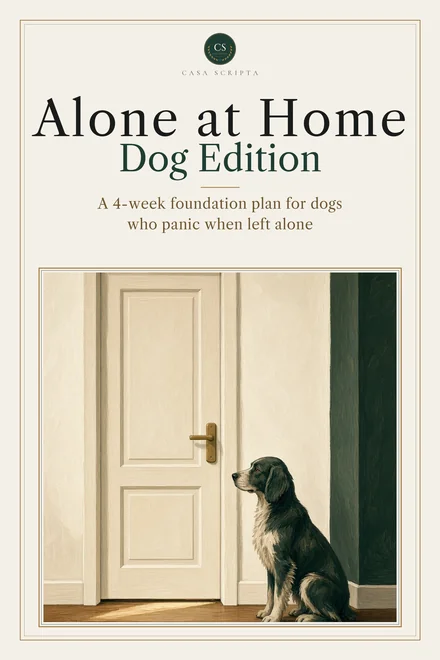
It's one of the first things people ask me when their dog struggles alone: how long is okay? Two hours? Four? A full workday? For a dog with separation anxiety, the honest answer is a little uncomfortable. It's only as long as your dog can stay calm, and at the start that may be minutes, not hours. The good news is that this number can grow. Here's how to find it, how to protect it, and how it gets longer.
Not veterinary advice. This is general information only. Talk to your vet or a qualified behavior professional about your dog. In an emergency, contact your nearest emergency vet.
The short answer: two different numbers
When you search this question, you'll see two answers that sound like they disagree. They don't. They answer different questions.
The general guideline for a relaxed adult dog is about four hours. The RSPCA recommends not leaving a dog alone "for more than four hours; for puppies much less" (RSPCA). Dogs Trust says that "if they're relaxed," a maximum of four hours on their own (Dogs Trust), and Blue Cross gives the same general rule while noting it depends on your dog, their age, breed and how they cope (Blue Cross).
Your anxious dog's number is their own. The same RSPCA page adds that a dog who struggles with being alone "may start feeling anxious within minutes of you leaving, or even before you leave." For that dog, four hours isn't a target yet. It's where training is heading.
Why the first minutes matter most
Separation anxiety isn't a slow build. When researchers filmed dogs with separation-related behavior, vocalizing started after an average of 3.25 minutes alone (Palestrini et al. 2010). The ASPCA notes that "most of your dog's anxious responses will occur within the first 40 minutes that he's alone" (ASPCA).
That changes how you think about the question. A dog who panics at minute three isn't helped much by you coming back at hour two instead of hour five. What helps is keeping absences short enough that the panic never starts.
How to find your dog's number
You can't guess this one, because many dogs look fine when you're home. You need to watch. Dogs Trust's advice is simple: "Spy on your dog!" (Dogs Trust). Any camera that records sound will do, such as an old phone or a laptop.
- Check the red flags first. If your dog has hurt themselves trying to get out, or tries to escape through doors or windows, talk to your vet before you test anything. I list the full set in my week-one plan for separation anxiety.
- Do one short, normal departure while you watch live on your phone from outside the door.
- Come back at the first sign of worry. Whining, pacing, panting, scratching at the door, drooling, or ignoring a food toy they'd normally love all count.
- Write down the time. If you saw worry at 90 seconds, your dog's number today is under 90 seconds.
Repeat on another day if you're unsure, and use the lower result. It may be humbling. That's fine. It's the starting line, not a verdict.
The rule while you train: stay under the number
This is the part that feels hardest and matters most. The ASPCA's rule is to "plan your absences to be shorter than the time it takes for your dog to become upset," and during treatment it says your dog "cannot be left alone except during your desensitization sessions" (ASPCA). Dogs Trust admits this takes organizing, but calls it "the only way to stop the problem getting worse" (Dogs Trust).
To be honest about the evidence: no study has tested this rule on its own. It's expert guidance that the major charities agree on. It also makes sense. Every long, panicky absence is practice at being scared alone.
In real life, staying under the number means a cover plan: friends or family, a pet sitter or dog walker, doggy daycare if your dog enjoys busy places, taking your dog with you, or working from home on some days. My week-one plan walks through building one in an evening.
How the number grows
The ASPCA lays out a rough road map for gradual training (ASPCA):
- Start tiny. Begin at an inside door, such as the bathroom, and step out for a few seconds. Come back calmly before your dog worries.
- Grow slowly. Over weeks, add only a few seconds each session, or every couple of sessions, depending on how your dog copes.
- Reach 40 minutes. This stage takes the most time, because it covers the window where most anxiety happens.
- Then larger steps. After 40 calm minutes, the ASPCA suggests 5-minute increases, then 15-minute increases.
- The milestone. Once a dog can be alone for 90 minutes without getting upset, the ASPCA says he "can probably handle four to eight hours," and suggests trying four hours first.
Notice the word "probably." That's the ASPCA's word, and I'd keep it. Even then, I'd follow the four-hour guideline from the UK charities and arrange a midday visit for long days.
How long does all this take? There's no fixed answer. In one UK trial, owner-led training ran for 12 weeks, and 56% of owners reported significant improvement by the end (Blackwell et al. 2006). Specialist Malena DeMartini advises owners to "think in terms of months, not weeks" (DeMartini). Results vary, and many dogs need months.
Crate or no crate?
A crate can feel like the obvious answer, especially in an apartment. The evidence says: test it carefully, and don't assume.
- A review of separation anxiety treatment found that dogs crated while home alone were no less likely to show separation-related problems, that crating can increase stress signals like lip licking, and that dogs can injure themselves trying to escape (Sargisson 2014).
- Dogs Trust says crate training alone "won't stop your dog worrying about being left," and warns of "a serious risk of injury if a dog panics when left alone in a crate" (Dogs Trust).
- The ASPCA suggests watching your dog in the crate while you're home. If you see heavy panting, drooling, frantic escape attempts, or persistent howling or barking, a crate isn't the right choice, and a room behind a baby gate is a gentler option (ASPCA).
Some dogs genuinely love their crate as a den. If yours does, keep it. Just don't use a closed crate to contain panic.
What about a full workday?
This is where it gets real for most people. If you work eight or nine hours away from home, your dog can't be left that long while you train, and even a relaxed dog would be over the four-hour guideline. So the plan for a workday is about cover, not endurance:
- a dog walker or sitter who comes in the middle of the day
- daycare on some days, if your dog copes well with busy, noisy places
- a friend, neighbor or family member who can take a shift
- working from home, or taking your dog to a dog-friendly workplace
You're not alone in this. PDSA's 2024 survey found 11% of UK dogs showed distress when left alone (PDSA PAW Report 2024).
Signs an absence was too long
Your camera is the best judge, but some clues show up when you get home: scratching or chewing around doors and windows, accidents in the house, a food toy left untouched, or a neighbor mentioning howling. The ASPCA notes that "highly anxious dogs usually won't eat when their guardians aren't home" (ASPCA).
If you see these, make the next absences shorter. Please don't punish the mess. Your dog can't connect it to something that happened hours ago, and it adds fear to an already scared dog (Blue Cross).
FAQ
Does a quick trip to the mailbox count? Yes. To your dog, a two-minute absence is still an absence. If their number is under two minutes, take them with you or skip it for now.
Will a long walk before I leave help? Exercise and mental stimulation help with boredom, and the ASPCA and Blue Cross both recommend them. They won't fix fear on their own, though, so keep absences under your dog's number either way.
Should I leave the radio or TV on? The RSPCA suggests a radio and closed curtains for dogs who bark at outside noise. There's no good evidence it treats separation anxiety, so treat it as a small comfort, not a plan.
What about calming products or medication? Talk to your vet. Don't give any medication, supplement or calming product without their advice.
You can also download our free Vet-First Red Flags Checklist, in A4 and US Letter.
FREE CHECKLIST BY EMAIL
Email me the Home Alone, Calmer checklist
Optional. We'll email you a link to confirm your address, and confirming opens the checklist. You'll also get occasional tips and new Casa Scripta guides; unsubscribe any time.
Want the whole plan?
If you'd like the steps laid out week by week, my Casa Scripta guide, Alone at Home, Dog Edition, includes a week-one cover planner, a 4-week foundation plan for growing your dog's number, and printable logs to track it. It's a plan, not a promise, and results vary. You can also read about it on the Alone at Home book page.
Sources
- ASPCA, Separation anxiety: https://www.aspca.org/pet-care/dog-care/common-dog-behavior-issues/separation-anxiety
- RSPCA, Separation-related behaviour: https://www.rspca.org.uk/adviceandwelfare/pets/dogs/behaviour/separationrelatedbehaviour
- Dogs Trust, Separation anxiety: https://www.dogstrust.org.uk/dog-advice/training/unwanted-behaviours/separation-anxiety
- Blue Cross, Home alone: https://www.bluecross.org.uk/advice/dog/home-alone-separation-anxiety-in-dogs
- PDSA PAW Report 2024: https://www.pdsa.org.uk/what-we-do/pdsa-animal-wellbeing-report/paw-report-2024/dogs
- Malena DeMartini, FAQs: https://malenademartini.com/faqs-unpacked-providing-answers-and-dispelling-myths/
- Studies linked inline: Palestrini 2010, Blackwell 2006, Sargisson 2014